How Mortgage Debt and Home Equity Affect College Financial Aid
Mortgage status significantly influences financial aid through asset assessment and income calculations. Federal and institutional methodologies treat home equity differently, directly impacting the Expected Family Contribution (EFC). Understanding these distinctions is critical for accurately forecasting aid eligibility and strategizing financial decisions.
Federal Methodology (FAFSA) and Primary Residence Exemption
The Free Application for Federal Student Aid (FAFSA) utilizes the federal methodology for determining eligibility for federal grants, loans, and work-study programs. A key provision is the explicit exclusion of equity in a family’s primary residence from reported assets. For instance, a home valued at $600,000 with a $200,000 mortgage yields $400,000 in equity, which is not reported on FAFSA. This exemption, outlined in Section 480(f) of the Higher Education Act, prevents homeownership from directly increasing a family’s EFC.
While home equity is not reported, associated mortgage interest payments can indirectly influence aid. For taxpayers who itemize deductions on Schedule A of Form 1040, mortgage interest reduces their Adjusted Gross Income (AGI). Since AGI is a primary component of the EFC formula, a lower AGI generally results in a lower EFC, potentially increasing federal aid eligibility. However, direct cash outflow for principal and interest payments is not a direct deduction in EFC calculations.
Institutional Methodology (CSS Profile) and Home Equity Inclusion
In contrast, many private colleges and some public institutions employing the College Scholarship Service (CSS) Profile utilize an institutional methodology that considers a broader range of assets, including home equity in the primary residence. Home equity is generally calculated as the current market value of the home minus the outstanding mortgage balance. For example, a home appraised at $750,000 with a $250,000 mortgage results in $500,000 in equity. A significant portion of this equity can be factored into the EFC.

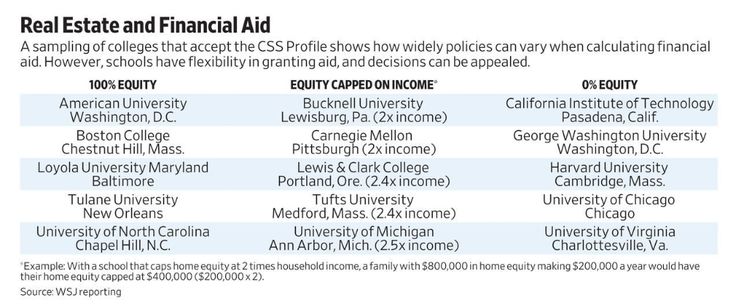
Institutions often apply an "equity protection allowance" to mitigate impact, varying widely (e.g., $100,000 to $200,000, or 1.2 to 2.0 times parental income). After this allowance, institutions might assess between 5% and 10% of the remaining equity. For a family with $500,000 in equity and a $200,000 protection, $300,000 is assessable. If 5% is assessed, this adds $15,000 to EFC-eligible assets, directly increasing the calculated EFC.
Impact on Available Income and Cash Flow
Beyond direct asset assessment, mortgage obligations significantly affect a family’s financial aid eligibility through their impact on available income and cash flow. Although FAFSA does not directly deduct mortgage payments, the total annual payment (PITI: principal, interest, taxes, insurance) constrains a family’s discretionary funds. A family with $150,000 gross annual income and $36,000 annual mortgage payments (24% of income) has reduced actual cash available for educational expenses.
From a tax perspective, itemized mortgage interest can reduce Adjusted Gross Income (AGI). If $15,000 in mortgage interest is itemized, it directly lowers taxable income and subsequently AGI, impacting both federal and institutional EFC calculations. A lower AGI often results in a lower EFC and increased aid eligibility.
Trade-off Analysis: Families face a trade-off between accelerated mortgage repayment and maintaining liquid assets. Accelerating payments reduces total interest (e.g., $20,000 savings on a $300,000 loan over 30 years by paying extra $100/month) but converts liquid cash (FAFSA assesses at 5.64% of parental assets) into illiquid home equity (exempt for FAFSA, but assessed by CSS Profile). The decision depends on target schools (federal vs. institutional methodology) and overall financial strategy.
| Feature | FAFSA (Federal Methodology) | CSS Profile (Institutional Methodology) |
|---|---|---|
| Primary Residence Equity | Explicitly excluded as a reportable asset | Generally included as a reportable asset |
| Home Equity Calculation | Not applicable | Fair Market Value – Outstanding Mortgage Debt |
| Equity Protection | N/A | Common; varies by institution (e.g., fixed amount, multiple of income) |
| Assessment Rate | N/A | Typically 5-10% of remaining assessable equity (after protection) |
| Impact on EFC | Indirect (via AGI reduction from interest deductions) | Direct (can significantly increase EFC based on assessed equity) |
| Applicability | All federal aid programs, most public colleges | ~200 private colleges, some public universities |
“The FAFSA’s primary residence exemption is a significant advantage for homeowners. Families with substantial home equity but limited liquid assets often find their EFC is lower under the federal methodology, compared to institutions that factor in home equity. This policy prevents families from being penalized for owning a home with illiquid equity.”
— Dr. Emily Chen, Senior Analyst, Education Finance Policy Institute
“For institutions using the CSS Profile, home equity represents a resource. Families must strategically manage assets, recognizing that converting liquid savings into accelerated mortgage payments might reduce assessable liquid assets for FAFSA, but could increase assessable home equity for CSS Profile schools depending on equity protection policies. Transparency and proactive communication with financial aid offices are paramount.”
— Mark Johnson, Certified Financial Planner specializing in College Funding
Strategic Considerations and Trade-offs
Navigating mortgage debt and financial aid requires strategic planning, particularly due to federal and institutional methodology differences.
Accelerating Mortgage Payments: Paying principal faster builds equity and reduces total interest. For FAFSA-only applicants, this is often beneficial as it converts assessable liquid assets into non-assessable home equity. However, for CSS Profile schools, building substantial equity could increase EFC if it exceeds institutional protection allowances. For example, moving $50,000 from a savings account (assessed at 5.64% on FAFSA, ~$2,820 EFC impact) into principal. If this $50,000 adds to home equity assessed at 5% by a CSS Profile school (after protection), it could add $2,500 to the EFC.
Refinancing for Lower Payments: Reducing monthly payments frees up cash flow. However, refinancing incurs closing costs (2% to 5% of loan, e.g., $6,000-$15,000 on $300,000 loan) and can extend the loan term, increasing total interest paid. While lower interest payments reduce AGI if itemized, the overall financial trade-off must be carefully evaluated against immediate cash flow needs and long-term costs.
Home Equity Lines of Credit (HELOCs) or Loans: Using home equity converts an illiquid asset into liquid cash. Any cash from a HELOC remaining in a savings account on the FAFSA application date is counted as a liquid asset (5.64% for parents, 20% for students), significantly increasing EFC. Debt from a HELOC is not directly subtracted from assets for FAFSA. For CSS Profile, its impact on net home equity is relevant.
Understanding Institutional Variations: Institutions using the CSS Profile have discretion. Families must investigate specific financial aid policies of each prospective college. Directly contacting the financial aid office clarifies their equity protection allowances and assessment rates, vital for precise planning.
FAQ Section
Does a second home or investment property affect financial aid?
Yes. Both FAFSA and CSS Profile consider any real estate beyond the primary residence (vacation homes, rental properties, land) as a reportable asset. These are assessed at their net equity (fair market value minus outstanding debt). FAFSA assesses parental assets (excluding primary home) up to 5.64% of adjusted net worth. CSS Profile also includes these, often with similar or slightly higher assessment rates, directly contributing to the EFC.
Can mortgage interest deductions lower my Expected Family Contribution (EFC)?
Indirectly, yes. Itemized mortgage interest on a primary residence reduces your Adjusted Gross Income (AGI). A lower AGI generally results in a lower EFC under both federal and institutional methodologies. However, this effect relies on itemizing deductions, which is less common since the 2017 tax reforms. Principal payments do not reduce AGI and thus do not directly impact EFC calculation this way.
How is home equity calculated for the CSS Profile?
For the CSS Profile, home equity is the fair market value of the primary residence minus the outstanding mortgage balance. For example, an $800,000 home with a $300,000 mortgage yields $500,000 in equity. Many institutions then apply an “equity protection allowance” (a specific amount or percentage of parental income) before assessing 5% to 10% of the remaining equity as an asset in the EFC calculation. This ensures not all home equity is treated as immediately available funds.